Tuesday, April 17, 2012

Monday, April 16, 2012
Presentations
Being sick for the majority of last week, I unfortunately missed the presentations. Although I was able to see Alex present the last time I went to class. Her presentation was on the city of Boston where she is from. She did a well job presenting the environmental issues that the city is combating. Mostly due to its size and its current growth rate. I liked how she touched upon many of the issues that are occurring in Boston as well as how they are combating them. This greatly improved her presentation, not just stating the problem but also the possible solutions. She did not focus on only one area and expanded her presentation to many issues. Which gave us a great over view of the issues impacting the city. Her presentation was colorful with many pictures that went along with her current topic. She gave the city a very positive view, sort of promoting it. Areas she could have improved upon was answer questions. I believe she just had a hard time understanding the questions than not knowing her content.
Tuesday, April 3, 2012
Education
This week I read Education and the Proliferation of New (Old) Concepts by Paul Theobald and Hibajene Shandomo. Where they discuss the evolution of the educational system. From the days when obtaining an education was a privilege to today when it is readily available. Before going to school meant parents paying out of their pockets. Where the alternatives where getting home schooled up to a certain point or start working. The children that had the opportunity to go to school took advantage of their circumstance, and saw an education as a way to better themselves. A way to learn and better themselves. Parents wanted to send their kids to school, and kids cared more about their education. Back then the only information available was through the books one had to read and teachers. Teachers where regarded with great honor. They held the key to the success of the next generation. In today’s modern world education is seen differently. Free education in the USA is available to all children till the time they graduate high school. If they choose to stick around that long. For the children that love learning school is a great experience. For the rest it is something that is being forced on them. School becomes a waste of time, a job they have to go to against their will where they receive no pay. Instead they receive an education. School is seen as a place to socialize which leads to disruptions in the classroom that cause a hindrances to the learning environment. If the students do not want to be at school they will not put any effort into it. Now what happens when the teacher does not what to be there? There are two types of teachers. The ones that are in the classroom to make a difference and enjoy their job, and the ones that are just there to be there. How can students learn when the person teaching them does not and can not teach. This leads to all sorts of problems in schools. What is needed is a widespread education reform. Where teachers that want to and can teach are put in the classrooms with a more appropriate pay. Where guidelines are put in place to keep students in line and on the path to graduation. Where parents and teacher are closer together leading to better communication between the two groups of people that influence children the most. The United States used to by the leader in education, now it just sits in the middle of the pack making slow progress. Students know have to worry about competition from students from other countries, countries that provide a better education.
Monday, March 26, 2012
Oppresion
“Indigenous Resistance and racist schooling on the borders of empires: Coast Salish cultural survival” by Michael Marker’s informs of us of the issue of assimilation. Towards the indigenous people of North American in the Washington State/Canada area during the 1800’s and the mid 1900’s. The tribes lived without borders throughout the area, then the white man came and imposed borders between families and friends. Separating families and friends, completely disrupting their way of life. Then to make matter worst the new Americans tried to eliminate the indigenous culture through the process of schooling. In the 1800 the children of the tribes were forced to attend boarding schools. Far away from their families and where they forced to abandon all of their traditions and accept the modern ways of life. The parents of these children would have rather had their children not attend school then loss their traditions. With grandparents becoming the most influential person in the tribe thanks to their knowledge and wisdom. Once children were stopped being forced to go to boarding schools by the federal governments they had to attend newly unsegregated public schools. The children that attended these schools faced harsh criticism and bullying for being different. In time the parents were choosing to send their kids to boarding schools, the same ones they had wanted to leave, instead of publics schools. There their children would be with other Native America just like themselves.
I enjoyed reading this article. It informed us on history of the United States that is not taught in school, coming from the “other sides” perspective. The perspective that is not often heard due to oppression and being forgotten. At first I had a hard time understanding what exactly what was happening. I felt like a lot was being thrown at me. As I read more the article started to take a chronological form. Then I was able to make out what was happening and relate it to everything else. I find the history of this country pretty brutal and horrendous. While the African-American population was dealing with their Civil Rights movement, other groups were also being oppressed. The indigenous people in this article are a fine example, but also the Chinese population along the west coast, Hispanic population along the South, and the German-Irish population of the 1800s. History is taught by the victors and their point of view. I would like to imagine a world were we all knew the very many different sides.
I enjoyed reading this article. It informed us on history of the United States that is not taught in school, coming from the “other sides” perspective. The perspective that is not often heard due to oppression and being forgotten. At first I had a hard time understanding what exactly what was happening. I felt like a lot was being thrown at me. As I read more the article started to take a chronological form. Then I was able to make out what was happening and relate it to everything else. I find the history of this country pretty brutal and horrendous. While the African-American population was dealing with their Civil Rights movement, other groups were also being oppressed. The indigenous people in this article are a fine example, but also the Chinese population along the west coast, Hispanic population along the South, and the German-Irish population of the 1800s. History is taught by the victors and their point of view. I would like to imagine a world were we all knew the very many different sides.
Friday, March 16, 2012
The Meatrix
The Meatrix presented information in a fun easy to learn way. The videos simplified all of its main points into a way that anyone could understand. The use of animations presented the information in a non-dull way. Making this viewer want to actually watch the video, as well as the sequels. I was a bit sad when it came to an end and there where no more clips. Using "The Matrix" as the setting for the videos, with their own twist, presented the content in a manner familiar to the audience. Having any one that has watch the original movies, or have an idea on what they are about, be able to draw connection between the two. Besides providing the main topics in a fun familiar way to the audience, at the end of the videos the characters informed the viewer on what he could do to help change the current situation. Including reading the labels of their foods more carefully, to try to stay away from factory farm products and support independent farms. As well as providing a website and link where more information on the topic and what can be done could be found.
Charlotte is the largest city in the the State of North Carolina. With a population of 1.8 million people. It is best know for its banking and not agriculture. To provide food for all of these people grocery stores can be found be practically found in every shopping center. With the grocery stores utilizing factory farms and manufacturing plants to provide their produce and goods. With only a small selection of organic and substitutable food sources sold. In the heart of the city it is very fast pace, with people always on the go. Due to this fast food establishments are one of the most common sites while on the road. These establishments are much worst then grocery stores when it comes to where their food comes from and what goes in it. That does not stop consumers from shopping at these restaurants due to the convenience of fast tasty food available whenever and wherever one will go.
While Charlotte is a massive city is is surround by many rural and urban communities. These communities- such as York County, Gaston County, Albemarle, Mattews, Monroe, and Mint Hill- are for the majority farm based. Instead of fast food restaurants dotting the country sides farms can be seen for as far as the eyes can see. These cities and counties help provide healthier food supplies to the city of Charlotte. I live on the outskirts of Charlotte. Just a 5 to 10 minute drive from my house I can visit a multitude of farmer markets. If I travel further down the road into South Carolina I can find immense farms, both factory and self sustained farms. If people took the time out of their busy schedules to take a ride to one of these local farms they actually buy and meet the people growing their food. Finding out exactly how their food is grown, helping slowly pull back the curtain put in placed by major companies.
Charlotte is the largest city in the the State of North Carolina. With a population of 1.8 million people. It is best know for its banking and not agriculture. To provide food for all of these people grocery stores can be found be practically found in every shopping center. With the grocery stores utilizing factory farms and manufacturing plants to provide their produce and goods. With only a small selection of organic and substitutable food sources sold. In the heart of the city it is very fast pace, with people always on the go. Due to this fast food establishments are one of the most common sites while on the road. These establishments are much worst then grocery stores when it comes to where their food comes from and what goes in it. That does not stop consumers from shopping at these restaurants due to the convenience of fast tasty food available whenever and wherever one will go.
While Charlotte is a massive city is is surround by many rural and urban communities. These communities- such as York County, Gaston County, Albemarle, Mattews, Monroe, and Mint Hill- are for the majority farm based. Instead of fast food restaurants dotting the country sides farms can be seen for as far as the eyes can see. These cities and counties help provide healthier food supplies to the city of Charlotte. I live on the outskirts of Charlotte. Just a 5 to 10 minute drive from my house I can visit a multitude of farmer markets. If I travel further down the road into South Carolina I can find immense farms, both factory and self sustained farms. If people took the time out of their busy schedules to take a ride to one of these local farms they actually buy and meet the people growing their food. Finding out exactly how their food is grown, helping slowly pull back the curtain put in placed by major companies.
Monday, March 12, 2012
Reading
The reading this week was on a topic I could really relate to- writing from a scientific view point. The chapter was titled, "Biotechnology: Building Consensus for Progress." It touched upon many key point on how to write a scientific paper. This included persuading with a balanced argument. Which is something I try to obtain in all my writing. Through the methods of stating facts and creditable sources, maintaining an unbiased tone, and presenting the information in a way that can be understood by everyone. Where I struggle is stating my own opinion in the writing, being able to fit it in with all the facts and statistics. What I have learned over the past couple weeks is to state a fact to support your argument and then elaborate on it. Slowly building up your own opinion on the subject. While maintaining a balanced reasonable argument.
The reading included in the chapter was by Gordon Conway and Gary Toenniessen titled, "Feeding the World in the Twenty First Century." It touched about the subject of genetically modified foods from a scientific biotechnology perspective. Previously I had written a paper on genetically modified foods but from an ethical and moral stand point. By completing the reading I was able to further learn about the subject. What I found more interesting was how the authors organized their topics, an area where I struggled with. Not just organizing but also the diction, tone, and style they used. Which was greatly different from mine. While I struggled to emphasize on my subject for my paper, Conway and Toenniessen smoothly transition from topic to topic. Relating it all back to their thesis. What I found was that when it comes to writing I would much rather take a scientific stand to my subject then a humanities viewpoint. I just find it easier and more comfortable.
The reading included in the chapter was by Gordon Conway and Gary Toenniessen titled, "Feeding the World in the Twenty First Century." It touched about the subject of genetically modified foods from a scientific biotechnology perspective. Previously I had written a paper on genetically modified foods but from an ethical and moral stand point. By completing the reading I was able to further learn about the subject. What I found more interesting was how the authors organized their topics, an area where I struggled with. Not just organizing but also the diction, tone, and style they used. Which was greatly different from mine. While I struggled to emphasize on my subject for my paper, Conway and Toenniessen smoothly transition from topic to topic. Relating it all back to their thesis. What I found was that when it comes to writing I would much rather take a scientific stand to my subject then a humanities viewpoint. I just find it easier and more comfortable.
Friday, March 2, 2012
Hydraulic Fracking

In the article I had to read this week hydraulic fracking was covered, more precisely how hydraulic fracking has led to water contamination in areas where it is implemented. In Wyoming the EPA drilled two water monitoring wells to the depth of 1000 ft. The test revealed high levels of carcinogenic chemicals such as benzene and 2 Butoxyethanol which are used in fracking. This problem occurred due to weakening of the cement barrier meant to protect the ground from the chemicals used in the well. Allowing gas and chemicals to leak into the ground and water source. Cases water contamination due to fracking have been on the raise in reason years. With hydrocarbons, methane, and other fracking chemicals found in drinking water. Leading the EPA to cation resident not to drink their water and ventilate their home. Due to the explosive properties of methane found in the water. When the concentration is high enough instead of a stream of water, a stream of fire will emit from the water faucet. The EPA took these water samples and concluded their test in 2008. Residents had been complaining of fouled water since the mid 1990s. The question is why did it take the EPA so long to respond when the problem had been made nice and clear? The only possible answer could be that the EPA is making deals with gas companies under the table to protect both their backs. At the cost of their consumers health.
Just recently a bill to allow hydraulic fracking in North Carolina was vetoed. As long as their are health issues associated with fracking it will meet opposition were ever it goes. Scientist and Engineers alike need to acquire a better understanding of the process. To find out what exactly is happening thousands of feet below them in the well and shales. So that the current issues can be handled. Once advancements are made and the process becomes safer to the environment fracking could become one of our main sources of energy. Helping the United States and other countries depend less on fossil fuels.
A video that explains fracking in a "hip" new way: http://www.youtube.com/watch?v=timfvNgr_Q4
http://www.propublica.org/special/hydraulic-fracturing-national
http://www.scientificamerican.com/article.cfm?id=fracking-linked-water-contamination-federal-agency
Monday, February 20, 2012
A Glimpse Of History- Ice Cores
http://earthobservatory.nasa.gov/Features/Paleoclimatology_IceCores/
In The Ends of the Earth: Perspectives on Modern Environmental History, Donald Worster tries to get the point across that environmental history has to form a tight alliance with science. To become more applicable and credible. Scientist are using ice cores to compose an environmental history of Earth.
Ice cores are cylindrical ice blocks removed from the Antarctic. When laid out vertically ice cores can give all type of information by the horizontal stripes formed from snow deposited. Similar to how tree trunk rings can provides on with information on the past. Throughout the years layers of snow fall upon the ice sheets. The layers of snow are each different with unique chemical make ups. During the summer months when Antarctica has 24 hours of sunlight the snow melts to form its own layer. Its these layers that scientist use to study the history of Earths climate. Ice cores have been pulled out from depths beyond 3000 m, 2 miles, and have recorded on them the history from 750,000 years ago.
Ice cores can provide many much information from their make up. With the right calculations they can find out a multitude of information from a block of ice. The thickness of each layer can be used to calculate the snow fall of any year. Chemicals found in the ice can tell of chemicals in found through out the atmosphere. If ash is found it can be concluded that their was a volcanic eruption in that time period; while the amount can conclude the magnitude of the eruption. Upon further studies ice cores can provide an annual record of temperature, precipitation, atmospheric composition, volcanic activity, and wind patterns. They are time capsules that allow us to look into the past.
Using information gather from these ice cores in Antarctica (as well as glaciers all over the world) and other means scientist are able to understand the Earth’s climate history. The ice has remain preserved and undisturbed providing a credible resource.
In The Ends of the Earth: Perspectives on Modern Environmental History, Donald Worster tries to get the point across that environmental history has to form a tight alliance with science. To become more applicable and credible. Scientist are using ice cores to compose an environmental history of Earth.
Ice cores are cylindrical ice blocks removed from the Antarctic. When laid out vertically ice cores can give all type of information by the horizontal stripes formed from snow deposited. Similar to how tree trunk rings can provides on with information on the past. Throughout the years layers of snow fall upon the ice sheets. The layers of snow are each different with unique chemical make ups. During the summer months when Antarctica has 24 hours of sunlight the snow melts to form its own layer. Its these layers that scientist use to study the history of Earths climate. Ice cores have been pulled out from depths beyond 3000 m, 2 miles, and have recorded on them the history from 750,000 years ago.
Ice cores can provide many much information from their make up. With the right calculations they can find out a multitude of information from a block of ice. The thickness of each layer can be used to calculate the snow fall of any year. Chemicals found in the ice can tell of chemicals in found through out the atmosphere. If ash is found it can be concluded that their was a volcanic eruption in that time period; while the amount can conclude the magnitude of the eruption. Upon further studies ice cores can provide an annual record of temperature, precipitation, atmospheric composition, volcanic activity, and wind patterns. They are time capsules that allow us to look into the past.
Using information gather from these ice cores in Antarctica (as well as glaciers all over the world) and other means scientist are able to understand the Earth’s climate history. The ice has remain preserved and undisturbed providing a credible resource.
Thursday, February 16, 2012
Religion and the Environment
Though we might not see it religion and the environment hold a very deep relationship. In the US 75% of the population describes themselves as either Christian or Catholic. Religions were people worship an almighty God. They pray for their health and the health of others, for a better life, more money, or a change in their life. These religions focus more on the relationship between them and their God.
This might seem strange to people of other religions. Especially the ones that value the environment as much as they value their God(s). Whose God(s) is not based around a person but a symbol of nature. Found common throughout many religions is the Sun God. The God that provides warmth and light to its followers.Who can cause a bountiful harvest or a drought that starves his people. In Hinduism it’s the God Surya “the Supreme Light”. Ra of the “the midday sun” was the ancient Egyptian Sun God. The ancient Greeks had Apollo whose chariot led the Sun across the sky. Another common theme between these religions and Christianity and Catholicism is the theme of light. On the first day God said,”Let their be light” which could imply towards the creation of the Sun. In these other religions near the beginning there was an absence of light which was provided by their Sun God. The Sun God is just one example that ties back to the environment. Other Gods can be traced back to the rain, the Earth, the Wind, the Oceans, and many other elements.
Monotheistic religions in the state find it harder to relate back to nature. While people all around the world seem to easily form a bound between their religion and their God(s). In some cases both being one in the same. Letting them have a better understanding of their surrounding and nature. People in America are disconnected from the environment. Their business life takes up their entire life and they barley have a chance to stop and smell the roses.
Monday, February 6, 2012
Ecopedagogy
Nature, and the Oppressed People of the Earth” written by Richard Kahn that touches upon many aspects of the environmental movement in industrial world that we live in. It helps paint a picture on the current view points that people hold on the environmental movement. By helping us understand how corporations and greed have led to the over consumption of our resources. As well as addressing the problem faced with teaching the next generation about the environment and sustainability.
As we begin the 21st Century we stand on the edge of an abyss we no way of turning back. In part to the progressive movement know as globalization. Kahn makes a reference to “The Enemy of Nature” by Joel Kovel. Which documented the degradation of of natural resources over the past 50 years. As well as “The Limits to Growth” which helps paint a picture of “political economy that is literally over-producing and consuming the planet towards death.” (Kahn pg.2) The rates at which resources are being consumed can be described as exponential equivalent to our population growth rate.
The current educational system is deemed inadequate at teaching environmental topics. Which have helped “developed ideas and practices of environmental preservation and conservation, struggled to understand and reduce the amount of pollution and toxic risks associated with industrialized civilization.” (pg. 5) The way environmentalism is taught at a basic lack theoretical and politicized coursework, while focusing on only the basics of the environment. Becoming more of an expansion to a biology course then its own. Which leads to misconception such as “45 million Americans think the ocean is a fresh source of water” (pg. 6) A great example brought up in Kahn’s essay is the School of Environmental Studies, or Zoo School. Where students attend school at the zoo grounds and nearby parks instead of the classroom setting. While still learning the basics taught in school they “ conduct independent studies and weave environmental themes into their curricular work.” (pg. 7) While it might seem like a poster child for the environmental movement it is still lacking. Focusing more on improving test scores and performance then addressing moral and political issues.
In the latter part of the essay Kahn addresses more of the political side of the environmental movement. Here it becomes quite easy to get lost and loss focus on the point Kahn is trying to get across. The reader can be overwhelmed with facts. From information and critique on the Earth Summits and Clinton era policies, to what environmentalist would like to seem changed in the system.
Kahn’s essay provides quite the deal of information. By stating his opinion on the matter as well as referencing the works of others such as Kovel, Scully, and many more. His writing was directed to a mature environmental audience with prior knowledge of his work and topics. Making ti quite the challenge to read. Through out his essay he makes many valid points; at times freely jumping around from one to another making it quite hard to follow. At times having to reread a section to get the full meaning. If the Kahn’s essay had been better organized with a natural flow it would have appealed to a much greater audience.
Kahn, Richard. "Towards Ecopedagogy: Weaving a Broad-based Pedagogy of Liberation for Animals, Nature, and the Oppressed People of the Earth."
Monday, January 30, 2012
DiHydrogen MonOxide
This week in class we discussed the prevalence of water. The importance of it to our civilization and the issues that concern it. The conversation was positive with everybody agreeing that their is an issue that has to be addressed. Water is being consumed at a rate faster then it can be replenished. To make matters worst as we remove water from the environment to sustain our needs we are destroying ecosystems and negatively changing the land. The best we can do is try to reduce water use, fix leaks, and reuse grey water. I found it crazy how the US has a population a third of China’s but uses nearly twice as much water. Water is being consumed at an alarming rate but even then it isn’t being distributed equally. While we have droughts here in the United States for a couple months a year we still have water available on a more limited supply. While in developing countries people are dehydrated due to ample supply of water year long. Water is the elixir of life, without it life would have never formed here on Earth. We as humans, and as caretakers, need to better manage one of our most valuable resources.
I am really loving these Google Alerts. The way I set them up I receive news articles on Green Architecture and Engineering. So I am receiving so much great information on sustainable ideas and concepts happening all over the world. I just love the look and feel of a modern contemporary green structure raising from the ashes.
 | ||
| See Tree Seen From Above Ground |
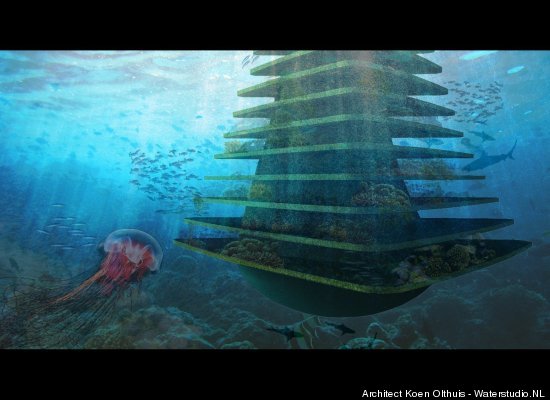 |
| See Tree Seen From Below The Waters Surface |
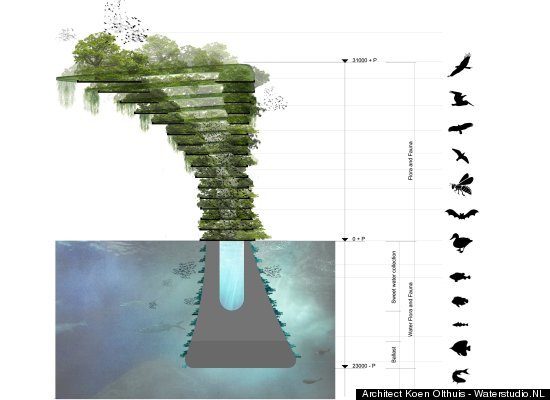 |
| Both Views With Distribution Of Life |
Friday, January 27, 2012
The End of a River is the Beginning of a New
The video describes how Lake Mead is drying up. Lake Mead is the largest reservoir in the United States. It was created when the Hoover Dam was built across the Colorado River. It supplies water to the majority of the population in southwestern corner of the United States. In the past couple of years it has been drying up after then expected. More water is being consumed then can be naturally replenished. In the video you can see clips where you can see past water level markings on the rock face. Those water marks are fresh with only a couple years in between.
The stories is set in a distant future. A possible future where Lake Mead has dried out. Causing the Colorado River to be covered with a 100 dams. To try to get as much water possible to the consumers and producers in the surrounding area. The ending to the story was a very nice surprise. It seems our explores found a paradise in a dead land by following a river to its end.
http://www.youtube.com/watch?v=acHhD67I9yw
http://www.patagonia.com/us/patagonia.go?assetid=62630
The stories is set in a distant future. A possible future where Lake Mead has dried out. Causing the Colorado River to be covered with a 100 dams. To try to get as much water possible to the consumers and producers in the surrounding area. The ending to the story was a very nice surprise. It seems our explores found a paradise in a dead land by following a river to its end.
http://www.youtube.com/watch?v=acHhD67I9yw
http://www.patagonia.com/us/patagonia.go?assetid=62630
Our Need For Water
In our lives we take simply things for granted; being able to go to the store and buying anything you’d like, being able to communicate with anybody anytime, having a roof over our heads, and being able to have a nice cup of cold water. To people in the United States water is a necessary and easy resource to come by. Walk to any facet and 99.99% of the time you shall receive a nice consistent flow of clean drinking water. People hardly ever stop to think about where this resource is coming from and how it manages to get to your home. Even during severe drought, when it is scarce, water is still easily obtainable.
Water is a resource. It is considered to be a renewable resource. Water is provided to you, it is used, returns to the “system”, somewhere in between it returns to the water cycle, before making it back into your home. Water is renewable but even it has its limitations. The amount of water on the Earth now is the same as when the dinosaurs where around. Over millions of years the quantity of this resource has hardly changed. Earth is considered to be the blue marble with 70% of its area covered in area. Of that seventy percent, 1% is freshwater. The human race has a ever growing population of 7 billion that has to manage with a limited supply of water. Our need for water is only going to keep increasing along with population, production, manufacturing, and energy rate. A great strain is being put on our limited supply.
Sandra Postel, director of the Global Water Policy Project, addresses the issues concerned with our water supply in her publication, Water Adapting to a New Normal. Postel states that our water problems are actually much more worrisome than our current energy situation. Currently there is water shortage around the world, no matter
what your kitchen faucet says. With such a large population water is needed to grow and be healthy, for production, for energy, for agriculture, and for consumption.1 As the need for water increases and the supplies remain the same we approach a shortage of water. Water shortages around the world are leading to, ”leading to economic disruption, food crises, social tensions, and even war.”
Water is our most valuable resource. More valuable then oil, coal, lumber, etc. Mrs.Sandra states that the three main points for the importance of water. It is necessary for life to exist. Without water we would dehydrate and not be able to produce goods. Unlike oil, water has no substitute. If global warming is a reality we shall experience its impacts of climate change most directly through water.
Postel then goes on to make a compelling case on the subject of water. By stating all of the shortages and droughts happening across the world. Water resources are being used faster then they can be replenished. Governments are trying to respond to these server shortages. Billions of dollars are used to help move water to our civilizations and even with that it is not enough. Construction projects to try to harness water cost millions, if not more, while damaging the ecosystem around at the same time. Causing more harm then good. While a dam and reservoir might fix the current ailment it does little to improve the situation to come.
The publication then goes on to list what cities and countries are doing to help improve the situation. New York city is investing $1.5 billion to restore and protect their watershed.2 Which shall cost them an additional $300 million a year. China has built the Three Gorges Dam. The single largest Earth moving project in existence. To help control the water supply of the Yangtze river and provide hydroelectricity. While Latin American countries are imposing fees to help reduce water use. Chicago is leading the race of green roofs with over 200. Green roofs help absorb and control storm water.
The topic then shifts from energy and polices to agriculture. The single largest user of our fresh water supply. If all anyone ate was grain, fruits, and vegetables water use in agriculture would significantly drop. To get 500 calories from beef it take twenty times the amount it would for 500 calories of rice. Grain has to be grown, harvested, and produced into feed. Animals then go on to eat large amounts of feed until they are large and ready for butchering. Some might say this is outrages but for us its just a way of life.
I really enjoyed reading the publication by Mrs. Sandra Postel. While it was lengthy it provided a great quantity and quality of information. She provided a history lesson on what has been done in the past and then takes us on a tour on what is currently going on with projects and polices around the world. While taking the environmental stand on the subject I don’t believe she can be considered bias and I or an extremist. She was just stating the facts as they are. People might ignore the current issues we are having with our water supply but Mrs. Postel is not shy about the subject. She conveys the information in an easy to read and follow manner.
I agree with the message Sandra Postel is trying to get across. Water is a valuable resource that is being diminished. Proper step need to be taken to try to conserve water, mostly through politics. The problem is politics takes to long or they don’t react until an event has happened. It comes down to money. The project needed to help conserve water cause hundreds of millions of dollars but these cost are nothing compared to what it will cost us to fix the problem in the future. If the shortage of water isn’t addressed now or in the near future it is only going to get worst.
Majoring in Civil Engineering one of the concentrations is hydrodynamics. Which deals with the movement of water and the construction of structures that can help in the process. I know from a recent presentation I went to recently that many cities across the nation are trying to reuse grey water. Grey water is the water we use to wash our hands, cook, do laundry, etc. For the majority the water is clean and returned to lakes and streams. Cities are trying to implement plans where instead of getting rid of the grey water they recycle it back into their facilities. Grey water is being used for irrigation, fountains, bathroom facilities, and other water supply that don’t require drinking water. Durham just spent 100 million dollars on a project that would help them deal with and reuses their supply of grey water. 100 million might seem excessive but the city actually saved money. It would have cost them upwards of 500 million to try to get a more viable water supply to the city. Most cities could love to implement these kinds of strategies, it is just the money thats holding them back. The small city of Chapel Hill is also implementing a program to recycle grey water. 3 They plan to incorporate it campus wise. Programs like these are small steps to trying to fix the water storage problem. They are helping reduce the need of water. We know we have a problem and we know what steps we have to fix it but it is going to take a lot of initiative politically to be able to reduce our need on water.
1. Postel, Sandra. "Water Adapting to a New Normal." The Post Carbon Reader Series: Water. Post Carbon Institute, 2010. Web. 25 Jan. 2012. <http://www.postcarbon.org/Reader/PCReader-Postel-Water.pdf>.
2. Postel, Sandra. "Water Adapting to a New Normal." The Post Carbon Reader Series: Water. Post Carbon Institute, 2010. Web. 25 Jan. 2012. <http://www.postcarbon.org/Reader/PCReader-Postel-Water.pdf>.
3. "Future/Potential Projects." School of Government. UNC. Web. 27 Jan. 2012. <http://www.sog.unc.edu/node/1049>.
Water is a resource. It is considered to be a renewable resource. Water is provided to you, it is used, returns to the “system”, somewhere in between it returns to the water cycle, before making it back into your home. Water is renewable but even it has its limitations. The amount of water on the Earth now is the same as when the dinosaurs where around. Over millions of years the quantity of this resource has hardly changed. Earth is considered to be the blue marble with 70% of its area covered in area. Of that seventy percent, 1% is freshwater. The human race has a ever growing population of 7 billion that has to manage with a limited supply of water. Our need for water is only going to keep increasing along with population, production, manufacturing, and energy rate. A great strain is being put on our limited supply.
Sandra Postel, director of the Global Water Policy Project, addresses the issues concerned with our water supply in her publication, Water Adapting to a New Normal. Postel states that our water problems are actually much more worrisome than our current energy situation. Currently there is water shortage around the world, no matter
what your kitchen faucet says. With such a large population water is needed to grow and be healthy, for production, for energy, for agriculture, and for consumption.1 As the need for water increases and the supplies remain the same we approach a shortage of water. Water shortages around the world are leading to, ”leading to economic disruption, food crises, social tensions, and even war.”
Water is our most valuable resource. More valuable then oil, coal, lumber, etc. Mrs.Sandra states that the three main points for the importance of water. It is necessary for life to exist. Without water we would dehydrate and not be able to produce goods. Unlike oil, water has no substitute. If global warming is a reality we shall experience its impacts of climate change most directly through water.
Postel then goes on to make a compelling case on the subject of water. By stating all of the shortages and droughts happening across the world. Water resources are being used faster then they can be replenished. Governments are trying to respond to these server shortages. Billions of dollars are used to help move water to our civilizations and even with that it is not enough. Construction projects to try to harness water cost millions, if not more, while damaging the ecosystem around at the same time. Causing more harm then good. While a dam and reservoir might fix the current ailment it does little to improve the situation to come.
The publication then goes on to list what cities and countries are doing to help improve the situation. New York city is investing $1.5 billion to restore and protect their watershed.2 Which shall cost them an additional $300 million a year. China has built the Three Gorges Dam. The single largest Earth moving project in existence. To help control the water supply of the Yangtze river and provide hydroelectricity. While Latin American countries are imposing fees to help reduce water use. Chicago is leading the race of green roofs with over 200. Green roofs help absorb and control storm water.
The topic then shifts from energy and polices to agriculture. The single largest user of our fresh water supply. If all anyone ate was grain, fruits, and vegetables water use in agriculture would significantly drop. To get 500 calories from beef it take twenty times the amount it would for 500 calories of rice. Grain has to be grown, harvested, and produced into feed. Animals then go on to eat large amounts of feed until they are large and ready for butchering. Some might say this is outrages but for us its just a way of life.
I really enjoyed reading the publication by Mrs. Sandra Postel. While it was lengthy it provided a great quantity and quality of information. She provided a history lesson on what has been done in the past and then takes us on a tour on what is currently going on with projects and polices around the world. While taking the environmental stand on the subject I don’t believe she can be considered bias and I or an extremist. She was just stating the facts as they are. People might ignore the current issues we are having with our water supply but Mrs. Postel is not shy about the subject. She conveys the information in an easy to read and follow manner.
I agree with the message Sandra Postel is trying to get across. Water is a valuable resource that is being diminished. Proper step need to be taken to try to conserve water, mostly through politics. The problem is politics takes to long or they don’t react until an event has happened. It comes down to money. The project needed to help conserve water cause hundreds of millions of dollars but these cost are nothing compared to what it will cost us to fix the problem in the future. If the shortage of water isn’t addressed now or in the near future it is only going to get worst.
Majoring in Civil Engineering one of the concentrations is hydrodynamics. Which deals with the movement of water and the construction of structures that can help in the process. I know from a recent presentation I went to recently that many cities across the nation are trying to reuse grey water. Grey water is the water we use to wash our hands, cook, do laundry, etc. For the majority the water is clean and returned to lakes and streams. Cities are trying to implement plans where instead of getting rid of the grey water they recycle it back into their facilities. Grey water is being used for irrigation, fountains, bathroom facilities, and other water supply that don’t require drinking water. Durham just spent 100 million dollars on a project that would help them deal with and reuses their supply of grey water. 100 million might seem excessive but the city actually saved money. It would have cost them upwards of 500 million to try to get a more viable water supply to the city. Most cities could love to implement these kinds of strategies, it is just the money thats holding them back. The small city of Chapel Hill is also implementing a program to recycle grey water. 3 They plan to incorporate it campus wise. Programs like these are small steps to trying to fix the water storage problem. They are helping reduce the need of water. We know we have a problem and we know what steps we have to fix it but it is going to take a lot of initiative politically to be able to reduce our need on water.
1. Postel, Sandra. "Water Adapting to a New Normal." The Post Carbon Reader Series: Water. Post Carbon Institute, 2010. Web. 25 Jan. 2012. <http://www.postcarbon.org/Reader/PCReader-Postel-Water.pdf>.
2. Postel, Sandra. "Water Adapting to a New Normal." The Post Carbon Reader Series: Water. Post Carbon Institute, 2010. Web. 25 Jan. 2012. <http://www.postcarbon.org/Reader/PCReader-Postel-Water.pdf>.
3. "Future/Potential Projects." School of Government. UNC. Web. 27 Jan. 2012. <http://www.sog.unc.edu/node/1049>.
Monday, January 23, 2012
Internship
It was 8:00 am. During my entire summer I could not remember being up this early- let along dressed. So there I was dressed sharply, wearing my ironed button up with a matching tie, long black slacks, and polished leather shoes. Holding a pen in one hand and folder in another. It was just the beginning of an interesting two week period.
When I had first sighed up for a summer internship, my junior year, I didn’t expect to hear back. Was I glad I was wrong when I heard back. I was going to take part in a Civil Engineering oriented internship at Charlotte Douglas International airport.1 The 25th largest airport in the United States. For two weeks I was going to be able to work along side Civil Engineers. There I was going to determine if Civil Engineers was the career path I wanted to truly follow. This opportunity just didn’t provide me the insight of what Civil Engineers do, it help me determine that it was what I wanted to do.
There I was again on Tuesday. Waiting in the main lobby of their new office building. Dressed as sharply as the day before, only two differences: I was wearing much sharper tie and my right, primary, arm was in a sling. The previous day I had met Kelly, construction manager; Rachel, civil engineer; John, project manager. They were going to be the ones watching over me for the upcoming two weeks and showing me the ropes. That first day I had gotten introduced to everyone in the office, explored the office, set in on a couple meetings, and got informed on what the heck I was going to be doing for my internship. I left “work” at 3 pm and shortly afterwards I was playing soccer with a couple friends at the park in 75 degree weather with Carolina blue skies and not a single cloud in sight. For that day I was stuck being goalie. All it took was a well placed kick and an amazing one handed save to send me to the emergency room with a broken wrist. The people in the office sure did a good laugh out of that one the next day.
Over the next two weeks I was able experience a day in the life of a civil engineer. Charlotte Douglas was going through a complete facelift. Its main terminal was being renovated, parking garages where being built, 2 new longer runways were being contracted, while all around bridges and roads where being built. The airport had every concentration of Civil Engineer on hand and I got to work along side a different one every day.
I had the opportunity to work along side geotechnical, materials, and water resource engineers. From watching them work in the office to out in the field around the airport. There were two fields that I found most appealing, which were structural and environmental engineers. Structural engineers work with the structures of buildings. They run calculations on the tension, compression, and stress that building components experience. To establish a weight and safety standard for the building. An old saying goes, “Whats the difference between a structural and software engineer? When you walk into a building you don’t worry about it crumble and crashing on you, while you’re lucky if you can check your email on a computer.” The reason this appealed to me so much is that I have a desire to build and construct structures. This would also explain my love for LEGOS. Structural engineers work the majority in the office while occasionally going on site visits. I would like a good mix of both, being able to work comfortably in an office or out on the field. Environmental engineering would allow be to do this. Environmental engineers work to make sure the construction process is safe for the environment and that the site is sustainable. I had such a great time working along side these two specialties. They really sparked an interest in me. The internship help me understand what Civil Engineers do better and confirmed that is was what I wanted to do with my life.
1. "US Airways Defying US Trends with Healthy Growth at Its Main Charlotte Hub | Anna.aero." Airline, Airport and Aviation Route News & Analysis | Anna.aero. PPS Publications Ltd, 2008. Web. 23 Jan. 2012. <http://www.anna.aero/2008/09/05/us-airways-defying-us-trends-with-healthy-growth-at-its-main-charlotte-hub/>.
When I had first sighed up for a summer internship, my junior year, I didn’t expect to hear back. Was I glad I was wrong when I heard back. I was going to take part in a Civil Engineering oriented internship at Charlotte Douglas International airport.1 The 25th largest airport in the United States. For two weeks I was going to be able to work along side Civil Engineers. There I was going to determine if Civil Engineers was the career path I wanted to truly follow. This opportunity just didn’t provide me the insight of what Civil Engineers do, it help me determine that it was what I wanted to do.
There I was again on Tuesday. Waiting in the main lobby of their new office building. Dressed as sharply as the day before, only two differences: I was wearing much sharper tie and my right, primary, arm was in a sling. The previous day I had met Kelly, construction manager; Rachel, civil engineer; John, project manager. They were going to be the ones watching over me for the upcoming two weeks and showing me the ropes. That first day I had gotten introduced to everyone in the office, explored the office, set in on a couple meetings, and got informed on what the heck I was going to be doing for my internship. I left “work” at 3 pm and shortly afterwards I was playing soccer with a couple friends at the park in 75 degree weather with Carolina blue skies and not a single cloud in sight. For that day I was stuck being goalie. All it took was a well placed kick and an amazing one handed save to send me to the emergency room with a broken wrist. The people in the office sure did a good laugh out of that one the next day.
Over the next two weeks I was able experience a day in the life of a civil engineer. Charlotte Douglas was going through a complete facelift. Its main terminal was being renovated, parking garages where being built, 2 new longer runways were being contracted, while all around bridges and roads where being built. The airport had every concentration of Civil Engineer on hand and I got to work along side a different one every day.
I had the opportunity to work along side geotechnical, materials, and water resource engineers. From watching them work in the office to out in the field around the airport. There were two fields that I found most appealing, which were structural and environmental engineers. Structural engineers work with the structures of buildings. They run calculations on the tension, compression, and stress that building components experience. To establish a weight and safety standard for the building. An old saying goes, “Whats the difference between a structural and software engineer? When you walk into a building you don’t worry about it crumble and crashing on you, while you’re lucky if you can check your email on a computer.” The reason this appealed to me so much is that I have a desire to build and construct structures. This would also explain my love for LEGOS. Structural engineers work the majority in the office while occasionally going on site visits. I would like a good mix of both, being able to work comfortably in an office or out on the field. Environmental engineering would allow be to do this. Environmental engineers work to make sure the construction process is safe for the environment and that the site is sustainable. I had such a great time working along side these two specialties. They really sparked an interest in me. The internship help me understand what Civil Engineers do better and confirmed that is was what I wanted to do with my life.
1. "US Airways Defying US Trends with Healthy Growth at Its Main Charlotte Hub | Anna.aero." Airline, Airport and Aviation Route News & Analysis | Anna.aero. PPS Publications Ltd, 2008. Web. 23 Jan. 2012. <http://www.anna.aero/2008/09/05/us-airways-defying-us-trends-with-healthy-growth-at-its-main-charlotte-hub/>.
Friday, January 20, 2012
Thursday, January 19, 2012
Sustainability
This week I looked into sustainability. I read up on the definition of sustainability: conserving an ecological balance by avoiding depletion of natural resources. As well as read up on what Wikipedia had to say on the topic. Coming into this I already had an idea of what sustainability was. After taking AP Earth Environmental in high school and ES 200 Climate Change and Sustainability the fall of my freshman year. The great thing about research is no matter how much you already know about a certain subject there is always so much more out there to learn and take in. I really enjoyed the Wikipedia article, with all of its links. I was able to get a better understanding on the history of sustainability and what direction it is heading.
Majoring in Civil Engineering, once I get out there in the real world I will be designing and doing calculations for structures such as homes, buildings, bridges, roads, and dams. If its being built there's a good chance that I might be working with it. Sustainability is an element I would love to implement into these projects. It is also the direction we are heading in; with over 60% of buildings being constructed achieving a LEED certification. In high school, for my senior exit, I wrote a research paper on green buildings incorporating LEED. Green buildings are buildings that use sustainable practices through out its construction process and continue to be sustainable throughout its lifetime. A green building is sustainable. LEED, Leadership in Energy and Environmental Design, is a program run by the US Green Building Commission. It provides incentives for builders to construct green buildings. As well as provide a certificate, ranging from: Certified, Silver, Gold, to Platinum, based on how sustainable a building is. As in high school, for my Civil Engineering and Architecture class I designed a home using green strategies, from the floor electrical plan up to a 3D rendering of the home. I was able to make my home green thanks to the materials I used, incorporating natural lighting using a considerable amount of windows, and an open floor for better circulation of air. To some extent you could say that sustainability is a part of who I am and what I do.
I played around with Google alerts for the first time. It’s an app that allows Google to sends me emails with webpages attached that relate to a subject of my choosing. I created three alerts that included Green Buildings, Green Architecture, and Sustainability. I received throughout the week 30 links to news articles that where based around these three topics. I had the opportunity to read up on green roofs, green skyscrapers in Chicago, how universities are incorporating green ideas, and many other articles. Instead of having to look for these article across the infinite realm of the internet, I had them delivered right to my GMail account. So far I only have it set up to receive only news articles but in the upcoming weeks I would like to add on discussion boards, videos, and other blogs. I’ll just have to make sure to be careful and not get overwhelm by all the reading I’m going to be doing.
Majoring in Civil Engineering, once I get out there in the real world I will be designing and doing calculations for structures such as homes, buildings, bridges, roads, and dams. If its being built there's a good chance that I might be working with it. Sustainability is an element I would love to implement into these projects. It is also the direction we are heading in; with over 60% of buildings being constructed achieving a LEED certification. In high school, for my senior exit, I wrote a research paper on green buildings incorporating LEED. Green buildings are buildings that use sustainable practices through out its construction process and continue to be sustainable throughout its lifetime. A green building is sustainable. LEED, Leadership in Energy and Environmental Design, is a program run by the US Green Building Commission. It provides incentives for builders to construct green buildings. As well as provide a certificate, ranging from: Certified, Silver, Gold, to Platinum, based on how sustainable a building is. As in high school, for my Civil Engineering and Architecture class I designed a home using green strategies, from the floor electrical plan up to a 3D rendering of the home. I was able to make my home green thanks to the materials I used, incorporating natural lighting using a considerable amount of windows, and an open floor for better circulation of air. To some extent you could say that sustainability is a part of who I am and what I do.
I played around with Google alerts for the first time. It’s an app that allows Google to sends me emails with webpages attached that relate to a subject of my choosing. I created three alerts that included Green Buildings, Green Architecture, and Sustainability. I received throughout the week 30 links to news articles that where based around these three topics. I had the opportunity to read up on green roofs, green skyscrapers in Chicago, how universities are incorporating green ideas, and many other articles. Instead of having to look for these article across the infinite realm of the internet, I had them delivered right to my GMail account. So far I only have it set up to receive only news articles but in the upcoming weeks I would like to add on discussion boards, videos, and other blogs. I’ll just have to make sure to be careful and not get overwhelm by all the reading I’m going to be doing.
Tuesday, January 17, 2012
This Land is My Land
It is estimated that our population shall reach 10 billion by 2050 if current trends continue. How is our future generation going to be able to feed these additional people when close to a billion people go by starving every day. As our population keeps expanding at an exponential rate it puts more pressure on the resources and lands we depend on so crucially. You have to ask yourself, “Are we demanding too much?”
Land is a valuable commodity. There is only a limited amount available. As a civilization we have to compare the opportunity cost of what to do with the land available. We need to preserve nature and try to leave as much land as possible untouched, what little of it remains. With our growing population we have to dedicate more land towards agriculture to feed our sprawling society. Of course we need land to live on, but with our ever growing population it is hard to give every man 40 acres and a mule. It is hard enough to find 40 acres that aren’t already owned, protected, or left barren to begin with. We our population growing so fast and land becoming so limited we have tough choices to make.
Now imagine an Earth 1000 years in the future. The human population has been drastically reduced to a fifth its current size. Where our descendants live in food producing, energy generating, waste managing independent like city state. Cut off from nature, to allow it to run its course. Where everything you could ever need would be available and provided in the bubble you call home. No longer would we have to depend on the surrounding land. Instead of growing outwards we could star looking and building towards the heavens above. Why have so many acres dedicated to farm land when you could have Vertical Farms inclosed in skyscrapers. Where people wouldn’t have to go a day without a meal. This is what Roderick Nash imagines in island civilization: A vision for human occupancy of Earth In The Fourth Millennium.
Despommier, Dickson. "The Rise Of The Vertical Farm." The Vertical Farm Project - Agriculture for the 21st Century and Beyond. 19 June 2011. Web. 15 Jan. 2012. <http://www.verticalfarm.com/>.
"Global Hunger - Bread for the World: Have Faith. End Hunger." Bread for the World: Have Faith. End Hunger. Web. 15 Jan. 2012. <http://www.bread.org/hunger/global/>.
Land is a valuable commodity. There is only a limited amount available. As a civilization we have to compare the opportunity cost of what to do with the land available. We need to preserve nature and try to leave as much land as possible untouched, what little of it remains. With our growing population we have to dedicate more land towards agriculture to feed our sprawling society. Of course we need land to live on, but with our ever growing population it is hard to give every man 40 acres and a mule. It is hard enough to find 40 acres that aren’t already owned, protected, or left barren to begin with. We our population growing so fast and land becoming so limited we have tough choices to make.
Now imagine an Earth 1000 years in the future. The human population has been drastically reduced to a fifth its current size. Where our descendants live in food producing, energy generating, waste managing independent like city state. Cut off from nature, to allow it to run its course. Where everything you could ever need would be available and provided in the bubble you call home. No longer would we have to depend on the surrounding land. Instead of growing outwards we could star looking and building towards the heavens above. Why have so many acres dedicated to farm land when you could have Vertical Farms inclosed in skyscrapers. Where people wouldn’t have to go a day without a meal. This is what Roderick Nash imagines in island civilization: A vision for human occupancy of Earth In The Fourth Millennium.
Despommier, Dickson. "The Rise Of The Vertical Farm." The Vertical Farm Project - Agriculture for the 21st Century and Beyond. 19 June 2011. Web. 15 Jan. 2012. <http://www.verticalfarm.com/>.
"Global Hunger - Bread for the World: Have Faith. End Hunger." Bread for the World: Have Faith. End Hunger. Web. 15 Jan. 2012. <http://www.bread.org/hunger/global/>.
Thursday, January 12, 2012
Man the Destroyer
Mankind has come far in the past 10,000 years. From our humble beginnings as hunter and gatherers to our ever growing magnificent cities and civilization. From fending off all of natures dangers to being called the “destroyer of worlds.” We have accomplished this with the combination of unprecedented technology advancements and our undesirable need to want to grow, expand, and conquer.
With this growth we are approaching a point where we require and want more then what the Earth has to offer. Humans are causing homeless, when we take unclaimed land for ourselves to call home. Humans are causing starvation, when we take more then what the oceans can replenish to feed our growing population. On this Earth there are over 1.5 million species with an average of 10,000 new species being discovered every year. In contrast an estimated 20,000 species go extinct every year, this is genocide. If humans continue of this current path its only of matter of time before Homo sapiens brings about the destruction of there own species.
The future is uncertain but there are many ideas of what might become of us. In the publication, Island civilization: a vision for human occupancy of EARTH In the Fourth Millennium, Roderick Frazier Nash touches upon four different scenarios in the year 3000. A wasteland scenario pictures an Earth (after possible nuclear war and years of neglect) trashed, poisoned, and slowly dying. His second scenario, the garden scenario, humans control everything. There is no more wilderness or biodiversity, if something exist it’s because we need it for our own survival. Where man has conquered the wilderness. As for a future where humans go back to their roots of hunting and gathering, leaving all technology behind is the future primitive scenario. Then there is Island Civilization.
Nash goes into great detail about Island Civilization. A world where the population would drop to 1.5 billion; all living in around 500 self sustaining city-state like habitats scattered across the Earth. This would be possible thanks to technological advancement and the imagination of engineers. The rest of the Earth would be left to alone. There would be minimal interaction between humans and nature. Animals could roam free without have to interact with man made object such as roads, fences, poles, building, or guns. Forest would prop up again with out the fear a human axe. The Earth would go back to its natural roots letting evolution and natural selection take its course, as it should be.
Nash’s vision might be called a Utopia. A world without wars or conflicts with a managed population in a controlled environment. The most favorable scenarios out of the four. The only issue is getting there. Even with a thousand years,getting our population cut down to a ⅕ of its current size would be quite the challenge. Countries would have to adopt polices similar to China’s One-Child policy. Every generation one child would replace his two parents, leading to a negative population growth. With this would come other challenges: tensions would raise between nation, economies would crash, and cities would be left abandoned. All that would be left behind would crumble. Nature with time would take back the abandon cities, roads, buildings, dams and transformed them into pastures, fields, forest, and flowing rivers. While mankind would go out on its own to reach its ultimate goal of Island Civilization. But for man to start anew, it has to leave everything be hide and first destroy itself.
With this growth we are approaching a point where we require and want more then what the Earth has to offer. Humans are causing homeless, when we take unclaimed land for ourselves to call home. Humans are causing starvation, when we take more then what the oceans can replenish to feed our growing population. On this Earth there are over 1.5 million species with an average of 10,000 new species being discovered every year. In contrast an estimated 20,000 species go extinct every year, this is genocide. If humans continue of this current path its only of matter of time before Homo sapiens brings about the destruction of there own species.
The future is uncertain but there are many ideas of what might become of us. In the publication, Island civilization: a vision for human occupancy of EARTH In the Fourth Millennium, Roderick Frazier Nash touches upon four different scenarios in the year 3000. A wasteland scenario pictures an Earth (after possible nuclear war and years of neglect) trashed, poisoned, and slowly dying. His second scenario, the garden scenario, humans control everything. There is no more wilderness or biodiversity, if something exist it’s because we need it for our own survival. Where man has conquered the wilderness. As for a future where humans go back to their roots of hunting and gathering, leaving all technology behind is the future primitive scenario. Then there is Island Civilization.
Nash goes into great detail about Island Civilization. A world where the population would drop to 1.5 billion; all living in around 500 self sustaining city-state like habitats scattered across the Earth. This would be possible thanks to technological advancement and the imagination of engineers. The rest of the Earth would be left to alone. There would be minimal interaction between humans and nature. Animals could roam free without have to interact with man made object such as roads, fences, poles, building, or guns. Forest would prop up again with out the fear a human axe. The Earth would go back to its natural roots letting evolution and natural selection take its course, as it should be.
Nash’s vision might be called a Utopia. A world without wars or conflicts with a managed population in a controlled environment. The most favorable scenarios out of the four. The only issue is getting there. Even with a thousand years,getting our population cut down to a ⅕ of its current size would be quite the challenge. Countries would have to adopt polices similar to China’s One-Child policy. Every generation one child would replace his two parents, leading to a negative population growth. With this would come other challenges: tensions would raise between nation, economies would crash, and cities would be left abandoned. All that would be left behind would crumble. Nature with time would take back the abandon cities, roads, buildings, dams and transformed them into pastures, fields, forest, and flowing rivers. While mankind would go out on its own to reach its ultimate goal of Island Civilization. But for man to start anew, it has to leave everything be hide and first destroy itself.
Subscribe to:
Comments (Atom)